



SURVEILLANCE FOR CENTRAL LINE-ASSOCIATED BLOODSTREAM INFECTIONS (CLABSIs): ACCURACY OF DIFFERENT SAMPLING STRATEGIES
METHODS: TDaily denominator data were collected in 22 units (4 PICUs, 12 NICUS and 6 ONCs) across Greece for 6 consecutive months. 32 sampling strategies were evaluated using the original data as following: 1 fixed day/week, 2 fixed days/week and 1 fixed week/month. CLDs for each month were estimated as follows: (number of CLDs in the sample/number of sampled days/month)*30. The estimated CLDs were used to calculate CLABSI rates. The accuracy of the estimated CLABSI rates was assessed by calculating the percentage error [(observed CLABSI rates-estimated CLABSI rates)/observed CLABSI rates].
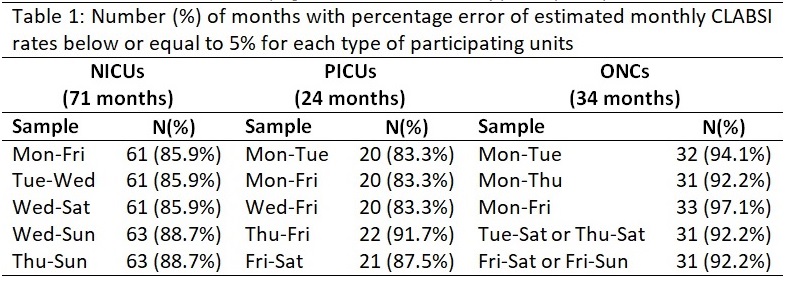
RESULTS: The sampling over 2 fixed days/ week seems to provide the most accurate estimates of the monthly CLABSI rates for all the different types of units compared to other strategies (1 fixed day/week, and 1 fixed week/month). The percentage error was found to be ≤5% in ≥85% of months in which sampling was conducted, for several day-pair samples as presented in Table 1. Moreover, results showed that lower number of CLD per month (cut-off 75 days) lead to more accurate estimate of CLABSI rates.
CONCLUSIONS: Sampling over 2 fixed days per week seems to provide a valid alternative to daily collection of CLABSI denominator data. These findings and similar strategies should be evaluated for the surveillance of other healthcare-associated infections.